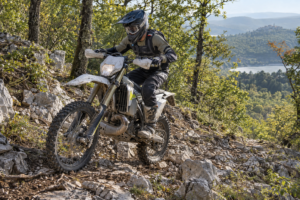
Few subjects divide enduro riders as reliably as the choice between two-stroke and four-stroke motorcycles. Some riders enjoy the agility and lively response of a two-stroke. Others prefer the controlled power, traction and engine braking of a four-stroke. Both sides can produce convincing arguments, usually supported by years of riding experience.
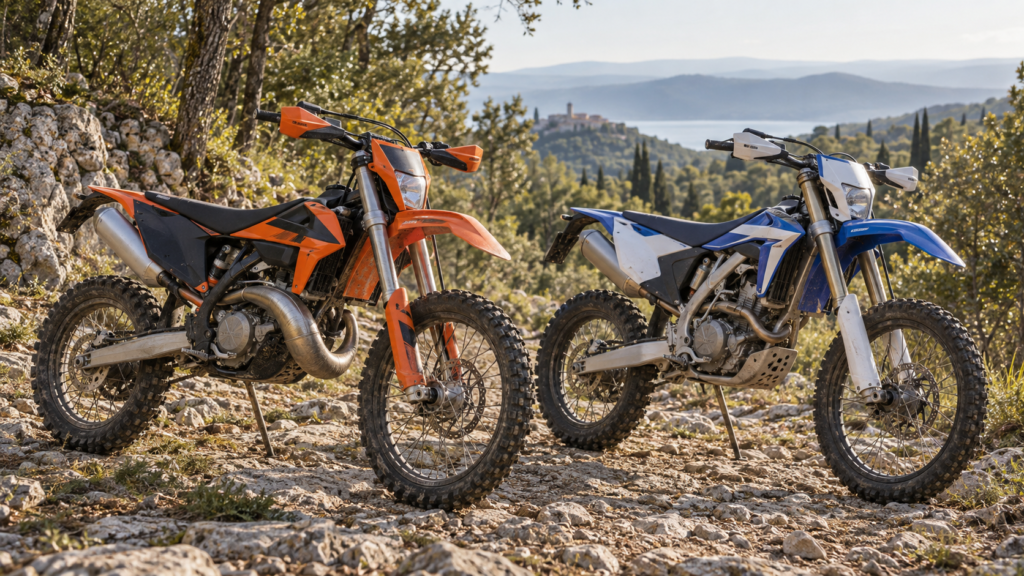
The problem with many two stroke vs four stroke enduro comparisons is that they reduce the decision to a few familiar claims. Two-strokes are described as light and aggressive, while four-strokes are presented as heavy but easy to control. There is some truth behind these descriptions, although modern enduro motorcycles are far more nuanced.
A fuel-injected 300 cc two-stroke can deliver remarkably manageable power at low revs. A 250 cc four-stroke may feel light, precise and eager to rev. Engine mapping, gearing, suspension, displacement and the rider’s technique all influence the experience.
The right question is therefore more personal: which engine helps you ride the terrain you encounter with greater control and less unnecessary fatigue?
What is the mechanical difference?
A two-stroke engine completes its combustion cycle in two movements of the piston, producing a power stroke during every revolution of the crankshaft. A four-stroke completes the cycle through intake, compression, combustion and exhaust, with a power stroke every two crankshaft revolutions.
This difference influences the construction of the engine and the way it delivers power. A two-stroke engine has fewer moving parts in its upper section and does not require the valves, camshafts and timing components found in a four-stroke. The resulting engine can be compact and relatively light.
A four-stroke engine is mechanically more complex, yet its combustion cycle creates a different type of response. Power often feels broader and more progressive, while the engine also produces considerably more braking when the throttle is closed.
These characteristics reach far beyond the workshop. They affect how the motorcycle changes direction, how the rear tyre finds grip and how much energy the rider spends during a long day.
How a two-stroke enduro feels on the trail
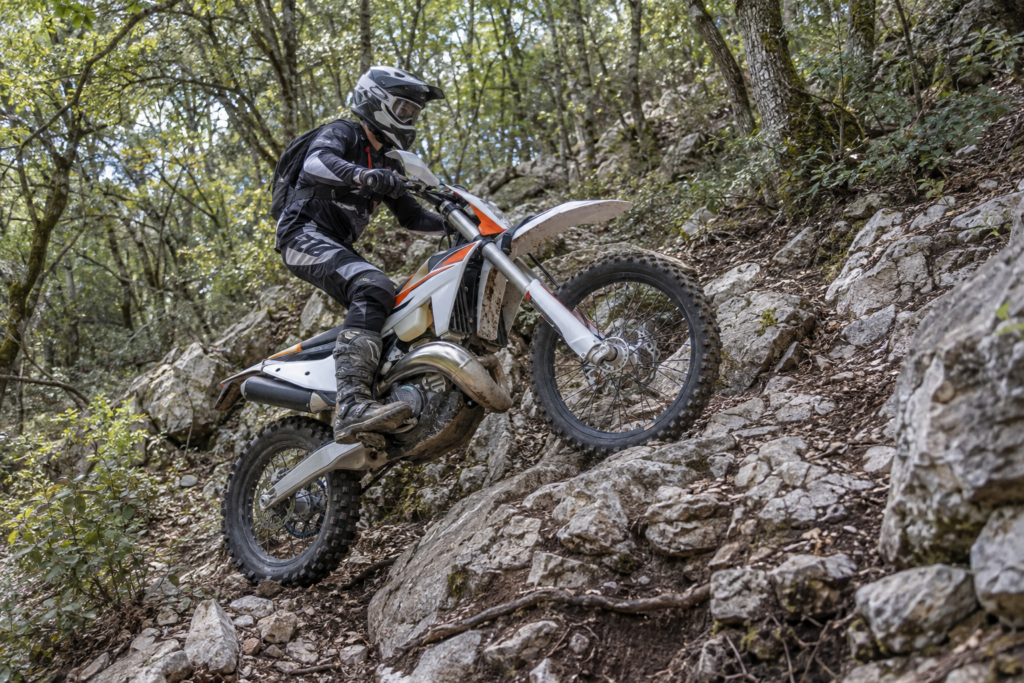
A modern two-stroke enduro motorcycle tends to feel light beneath the rider, especially when the trail becomes narrow or awkward. The difference is partly visible on the scales, but it is also related to rotating mass. The engine can feel more willing to change speed and direction, giving the motorcycle an agile character.
This becomes valuable in tight woodland, rocky gullies and technical climbs. When the front wheel needs to be lifted over a ledge, a quick clutch and throttle input can produce an immediate response. If the motorcycle begins to lean too far or gets trapped against a rock, the lower perceived weight can make it easier to correct.
On larger two-strokes, particularly modern 250 and 300 cc enduro models, low-rev power can be much smoother than riders expect. They can crawl through difficult terrain with useful torque, then respond quickly when the trail opens.
Smaller engines behave differently. A 125 cc or 150 cc two-stroke usually requires more revs, better clutch timing and a greater willingness to carry momentum. It can teach accurate riding, although it may demand considerable work from a rider who expects to climb everything at low engine speed.
Where the two-stroke requires attention
The responsive character that makes a two-stroke entertaining can also punish an abrupt throttle hand. A sudden increase in power on wet roots, polished stone or loose soil may break traction before the rider has time to adjust.
Clutch control plays a particularly important role. Skilled riders use the clutch to shape the delivery, keep the engine within its useful range and generate a short burst of power when they need to lift the motorcycle over an obstacle. For someone still developing this coordination, the engine can initially feel busy.
A two-stroke also offers relatively little engine braking. Closing the throttle on a descent will not slow the motorcycle as strongly as it would on most four-strokes. The rider must rely more deliberately on both brakes and maintain an active position.
How a four-stroke enduro feels
A four-stroke enduro bike usually delivers power in a broad, predictable manner. The rear tyre feels connected to the throttle, and the rider can often build speed without the same abrupt transition associated with some two-strokes.
On flowing trails, long climbs and terrain where steady traction matters, this character can be reassuring. The motorcycle carries momentum well and allows the rider to meter out power with small throttle movements. A four-stroke can feel planted when the trail becomes faster, especially across open ground or rough sections taken at speed.
Engine braking is another noticeable part of the experience. When the throttle closes, the engine helps slow the motorcycle. Many riders appreciate this on long descents because it supports the brakes and creates a familiar sense of control.
That same engine braking can require adaptation in slippery terrain. An abrupt throttle closure may load the front wheel or influence rear-wheel grip. Smooth four-stroke riding involves managing both acceleration and deceleration with care.
The effect of additional weight
Comparable four-stroke models often carry more engine weight and rotating mass. During normal riding, the difference may feel modest. It becomes more noticeable when the motorcycle needs to be lifted, turned on a steep slope or recovered several times during a difficult section.
The four-stroke can also feel more stable because of this mass. A rider crossing loose stones at speed may value the planted sensation that becomes tiring during a slow struggle between rocks. Terrain changes whether the same characteristic feels like an advantage or a drawback.
Two stroke vs four stroke enduro in technical terrain
Hard enduro has helped establish the 300 cc two-stroke as a favourite for extreme terrain. Its combination of manageable low-end power, strong response and relatively low weight suits sections where riders must hop over logs, restart on steep slopes and make rapid corrections.
Current KTM enduro ranges, for example, position their lightweight two-stroke models toward technical and hard-enduro use, while describing their four-stroke range in terms of tractable power, stability and performance at higher speeds.
This does not mean a four-stroke cannot perform in difficult terrain. A skilled rider can take one through extremely technical routes, and the steady torque can create excellent traction. The greater challenge arrives when the motorcycle loses momentum or has to be physically repositioned.
For the average recreational rider, fatigue matters as much as outright engine performance. A motorcycle that feels comfortable for twenty minutes may become demanding after several hours of failed climbs, tight turns and repeated recoveries.
Which engine is better on fast, flowing trails?
Four-strokes often feel at home on flowing trails where the rider can maintain speed and use the engine’s broad power. They hold a line well, find traction under acceleration and feel composed across repeated bumps.
The difference becomes especially noticeable with 350 cc and 450 cc models. They can cover ground quickly without requiring frequent gear changes. That ability is useful on open trails, although the larger models can also deliver more power than a recreational rider needs.
A two-stroke remains very capable in flowing terrain. It tends to feel lively and can change direction quickly, but some riders find that its lighter sensation requires more attention at speed. Others enjoy exactly that responsiveness.
Suspension setup and chassis geometry have a major influence here, so engine type should never be treated as the only factor.
Is a two-stroke or four-stroke better for beginners?
There is no universal beginner engine. The answer depends greatly on displacement.
A manageable 250 cc four-stroke is often a comfortable place to begin. Its progressive response helps the rider understand traction, and engine braking can provide additional confidence on descents. The rider can concentrate on body position and line choice without constantly searching for the correct part of the power range.
A modern 250 or 300 cc two-stroke can also be surprisingly friendly when it has a smooth enduro-specific setup. It offers useful low-speed power and feels easier to manage physically when the route becomes tight. However, the immediate response and reduced engine braking still require good control.
Small-capacity two-strokes are light, but light does not automatically mean easy. A 125 cc model may ask the rider to use the gearbox and clutch continuously. This can be enjoyable and educational for an athletic rider who wants to develop technique. It can also make a first technical tour far more tiring than expected.
When selecting the best enduro bike for a beginner, seat height, suspension setup, power delivery and general condition may matter more than the simple choice between two and four strokes.
Maintenance and running costs
Two-stroke engines have a simpler upper-engine design. Piston replacement is generally more straightforward because there are no valves or camshafts to inspect and time. Top-end work may be required more frequently, depending on the motorcycle, hours of use and riding conditions, but the individual job is usually less complicated.
Four-strokes can run for many hours when they are serviced correctly. Oil changes, air-filter care and valve-clearance inspections must follow the manufacturer’s schedule. If major engine work eventually becomes necessary, the number and cost of internal components can make the repair more expensive.
A two-stroke also consumes engine oil as part of its normal operation. Depending on the model, oil is either mixed with the fuel or delivered by a separate injection system. Many current two-strokes use electronic fuel injection, so the old comparison of “carburetted two-stroke versus injected four-stroke” no longer describes the modern market accurately. Manufacturers such as Husqvarna currently offer both injected two-stroke and four-stroke enduro ranges.
Real ownership costs depend heavily on maintenance habits. A carefully serviced motorcycle of either type is usually a better purchase than a neglected example chosen because its engine configuration appears cheaper on paper.
Fuel range and multi-day enduro riding
Four-strokes are often more economical with fuel, which can become relevant on long routes where filling stations are limited. Modern fuel-injected two-strokes have improved considerably, but fuel range still deserves checking before a full-day or multi-day tour.
Consumption also depends on terrain. Deep mud, repeated climbs and frequent clutch use can change the numbers quickly. Tank capacity, available spare fuel and the planned distance between stops matter more than an optimistic figure taken from an easy ride.
Fatigue should enter the calculation as well. A lighter two-stroke can save energy in slow technical sections. A stable four-stroke may require less concentration on long, flowing routes. The motorcycle that helps you finish comfortably is not necessarily the one with the lowest quoted weight or the largest fuel tank.
How to choose between a two-stroke and four-stroke enduro
Think about the terrain you ride most frequently. Tight forests, rock steps, steep technical climbs and hard-enduro obstacles tend to highlight the strengths of a two-stroke. Open trails, sustained climbs and faster, flowing ground often suit a four-stroke’s stability and broad power.
Your riding style matters just as much. A rider who enjoys using the clutch, changing direction quickly and actively moving the motorcycle may feel immediately comfortable on a two-stroke. Someone who prefers to build momentum smoothly and ride on predictable torque may connect more naturally with a four-stroke.
Physical effort can guide the decision too. If lifting and manoeuvring the motorcycle causes problems, lower weight becomes important. If throttle control is still developing, a calm four-stroke or softly mapped larger two-stroke may provide a better learning environment.
Whenever possible, ride both engines on comparable terrain. A short test on a flat road reveals very little. The useful comparison begins when you encounter slow turns, loose climbs, descents and sections where traction changes.
The best engine is the one that suits the whole ride
The 2 stroke vs 4 stroke enduro question has no winner that applies to every rider. Two-strokes bring agility, a simple engine layout and an immediate character that works beautifully in technical terrain. Four-strokes offer progressive power, strong traction and stability that many riders appreciate over fast or flowing ground.
Displacement can change these characteristics significantly. A high-revving 125 cc two-stroke, a tractable 300 cc two-stroke, a light 250 cc four-stroke and a powerful 450 cc four-stroke provide four very different experiences. Comparing only the combustion cycle leaves out much of what determines whether a motorcycle feels right.
The terrain itself may ultimately give you the clearest answer. Our article on how riding different types of terrain improves your enduro skills explains how changing surfaces reveal different aspects of motorcycle control.
If you would like to experience enduro on the varied terrain of Istria, explore the Enduro Experience Croatia packages. Riding routes adapted to your level gives you the opportunity to understand how different motorcycles behave in the conditions that matter, while enjoying several days of guided enduro in Croatia.