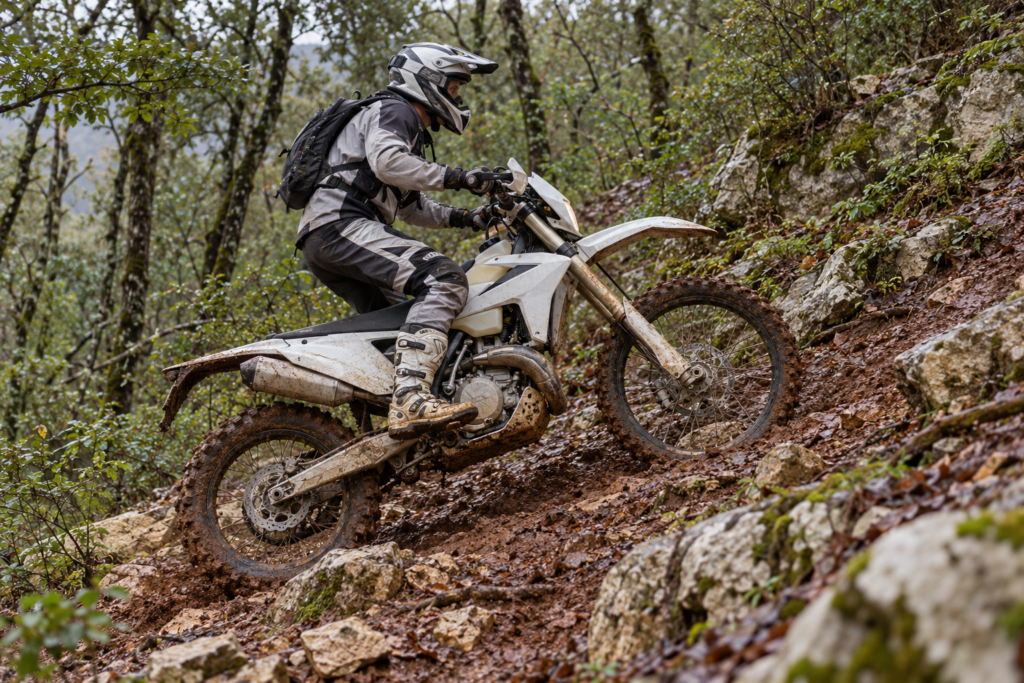
A trail can feel completely familiar on Saturday and almost unrecognisable after a night of rain. The rocks are still in the same places and the climb has not become any steeper, yet the motorcycle begins moving sideways, the front wheel searches for a line and every throttle input feels larger than it did the day before.
This is why riders who are comfortable in dry conditions can suddenly feel like beginners in the mud.
Learning how to ride a dirt bike in mud is not mainly about becoming more aggressive or forcing the motorcycle through. Mud rewards the rider who notices small changes in grip, keeps the controls smooth and allows the motorcycle to move without reacting to every slide as an emergency.
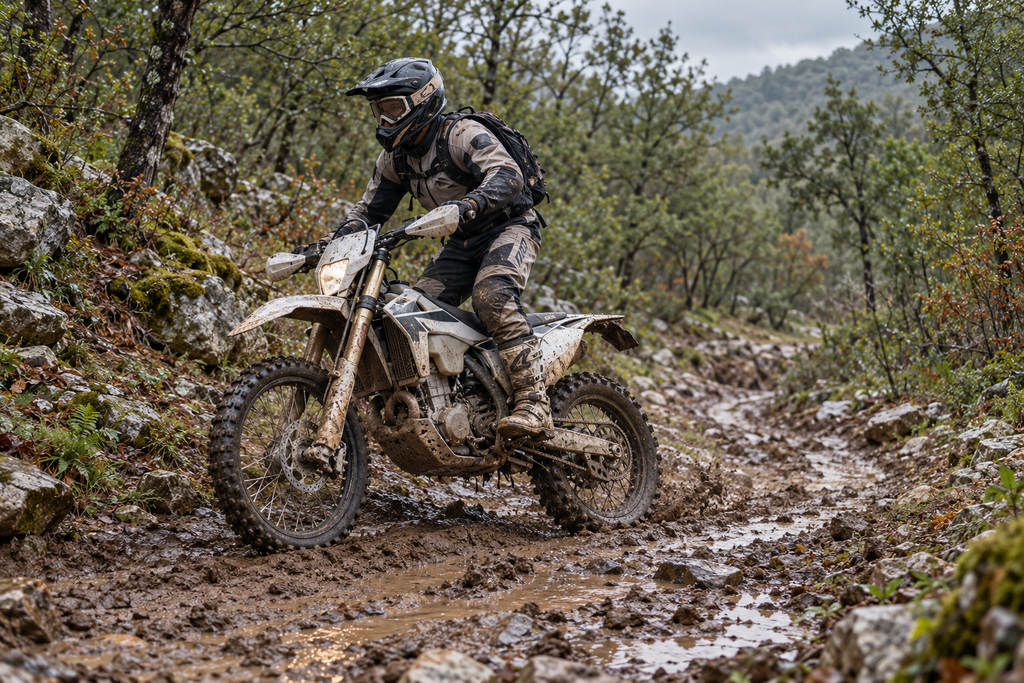
After years of guiding enduro groups, we have seen the same pattern many times. The rider who attacks the mud with high revs usually creates more wheelspin. The rider who becomes completely cautious loses momentum and gets stuck. Somewhere between those two reactions is the controlled, steady approach that keeps the motorcycle moving.
Mud is not one type of terrain
Before thinking about technique, look at the surface in front of you. “Mud” can describe several very different conditions.
Thin mud over hard ground can be extremely slippery because the tyres have little material to penetrate before reaching a smooth base. Deep, soft mud may allow the tyre to dig and find some grip, but it creates more rolling resistance. Clay can become polished and hold tightly to the tread. Wet forest soil may offer reasonable traction until it is crossed by roots or fallen leaves.
The same input will not work on every surface.
Watch the riders ahead, but do not automatically follow their exact line. Their rear wheels may have removed the soft upper layer and exposed firmer ground. They may also have polished the line until it offers even less grip.
Pay attention to how much mud sticks to the tyres, how deeply the wheels sink and whether existing tracks are helping motorcycles move or pulling them into deeper ruts.
Good muddy enduro riding begins before the front wheel enters the difficult section. Read the ground, choose a likely exit and decide where you need momentum.
Look where you want the motorcycle to go
Mud makes it very tempting to stare at the front wheel. It moves from side to side, drops into tracks and appears to require constant supervision.
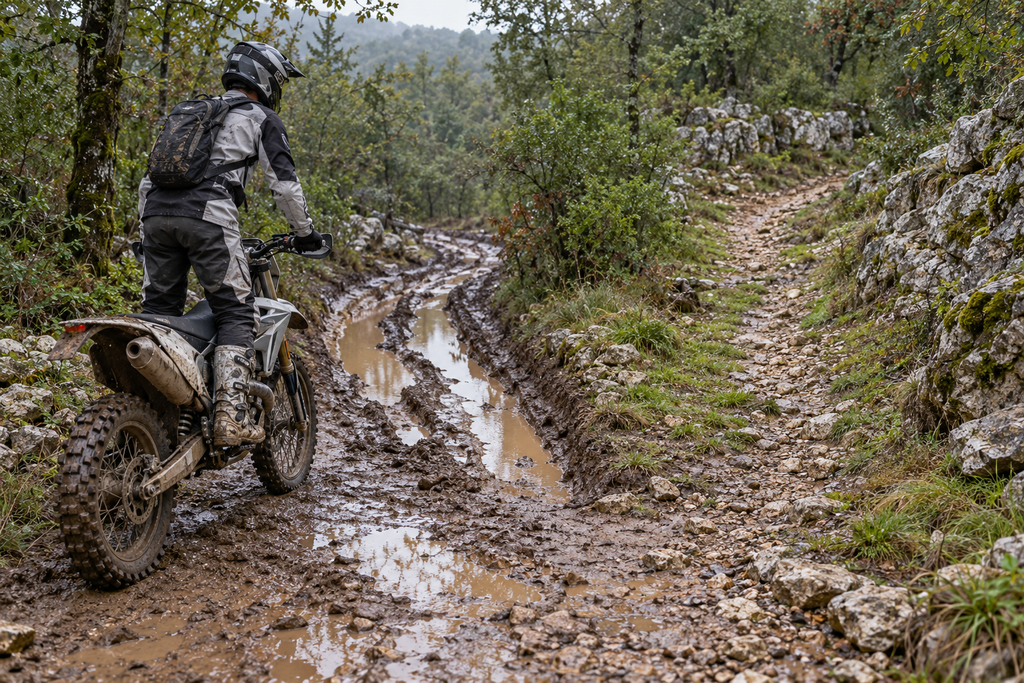
Looking down usually makes the problem worse. You see obstacles too late, the upper body becomes tense and every small movement of the motorcycle feels more dramatic.
Keep your eyes farther ahead. Look towards the part of the trail where you want to arrive, then allow your peripheral vision to monitor what is happening closer to the motorcycle.
This becomes especially important in ruts. If you stare at the side of the rut, your body and handlebars often begin directing the motorcycle towards it. Looking through the rut towards its exit helps you maintain a steadier line.
You will not always hold the exact line you planned. Mud involves movement. The aim is to keep the motorcycle travelling generally in the intended direction, even if both wheels make small corrections along the way.
Momentum matters, but speed is not the same thing
Riders are often told to “keep the momentum” in mud. The advice is correct, but it is easily misunderstood.
Momentum does not mean entering every muddy section as quickly as possible. Excessive speed gives you less time to read the surface and makes a sudden loss of grip more difficult to manage. Too little speed allows the tyres to sink, removes stability and may leave the motorcycle without enough drive to cross the soft ground.
Useful momentum is controlled forward movement.
Before entering the mud, select a speed that you can maintain without abrupt acceleration or braking. Try to keep the wheels rolling and avoid unnecessary stops in the deepest part of the section.
If the rear wheel begins to spin, adding more throttle rarely produces the missing forward movement. The engine becomes louder while the tyre digs deeper. A small reduction in power may allow the tread to regain contact and begin driving again.
Learning how to ride a dirt bike in mud means developing a feel for the difference between productive wheel movement and wheelspin that is only moving soil.
Stay loose when the motorcycle moves
A motorcycle will rarely feel perfectly settled in slippery mud. The front wheel may wander and the rear may step sideways. These movements do not automatically mean that the motorcycle is falling.
A tense rider reacts to every slide through the handlebars. The corrections become larger, the front tyre receives conflicting instructions and the motorcycle moves even more.
Keep your knees and elbows flexible. Hold the handlebars firmly enough to control the motorcycle, but avoid gripping them as though they were preventing you from falling. Let the lower body absorb movement and allow the motorcycle to find its way through small changes in the surface.
Standing on the footpegs is often useful because your legs can respond when the motorcycle moves beneath you. It also makes it easier to shift pressure between the front and rear wheels.
Standing does not mean locking the legs or squeezing the motorcycle continuously. Remain low enough to move, with slightly bent knees and a relaxed upper body.
On a smooth, slippery turn, sitting forward may offer more front-wheel grip and help the motorcycle change direction. As with most enduro technique, the position should respond to the terrain rather than follow a fixed rule.
Be gentle with the throttle
Abrupt throttle inputs are one of the fastest ways to lose traction.
The rear tyre can only transmit a limited amount of engine torque before it begins to spin. In mud, that limit is lower and changes constantly. A throttle position that works on firmer soil may become excessive as soon as the tyre reaches polished clay or a wet root.
Open the throttle progressively and listen to the engine. You are trying to create steady drive, not the greatest possible amount of power.
A taller gear can sometimes soften the response and reduce sudden wheelspin. This works particularly well on motorcycles with strong low-speed torque. The engine should still remain within a range where it can continue pulling without labouring or stalling.
A gear that is too high may force you to slip the clutch continuously, creating heat and making the motorcycle difficult to control. A gear that is too low can make every throttle movement more immediate.
The correct choice depends on the engine, slope and consistency of the mud. Use the gear that allows the calmest connection between your right hand and the rear tyre.
Use the clutch to shape the power
The clutch becomes especially useful when available grip changes within a few metres.
Instead of repeatedly opening and closing the throttle, maintain a controlled engine speed and use small movements around the clutch’s friction zone to regulate how much power reaches the rear wheel.
If the tyre begins spinning, pulling the clutch in slightly reduces the torque being transferred. When the tyre regains grip, release the lever progressively and allow the motorcycle to drive forward.
The movements should remain small. Continually holding high engine revs against a half-engaged clutch generates unnecessary heat and can quickly wear the plates.
Good clutch use makes muddy enduro riding appear calmer. The motorcycle continues moving without dramatic changes in engine speed, while the rider adjusts the delivery according to the grip available.
Our guide to enduro clutch control explains how to use the friction zone on loose climbs, slow turns and obstacles without overheating the clutch.
Choose a line that offers something to the tyres
The most obvious line is not always the one with the most grip.
A deep rut may guide the motorcycle and prevent the wheels from sliding sideways. It may also become so deep that the footpegs, engine or frame begin dragging through the mud. A flat section beside the rut may look easier while hiding polished clay beneath a thin layer of water.
Look for texture. Grass, small stones and firmer edges can give the tyre something to work against. Fresh soil outside the most heavily used track may provide better traction than the dark, polished line followed by every previous motorcycle.
Roots require particular care. A wet root crossed at a shallow angle can push either wheel sideways. Whenever possible, approach closer to a right angle and cross with steady drive. Avoid accelerating, braking or turning sharply while the tyre is directly on the root.
The same principle applies to wet logs, flat rocks and wooden bridges. Complete your main steering or braking input before reaching the slippery surface, cross it with the motorcycle reasonably upright and make the next change after the tyres have returned to better ground.
How to ride through muddy ruts
Ruts can be helpful when they run in the right direction. They hold the wheels on a defined path and reduce some sideways movement. The challenge begins when the rut becomes deep, changes direction or is already filled with water.
Before entering, look along the entire section you can see. Check whether the rut has an exit and whether it becomes too deep for the motorcycle. A line that appears easy at the entrance may end against a root, rock or hidden hole.
Once inside, avoid fighting every contact with the sides. Keep looking towards the exit and let the front wheel follow the channel. Maintain enough momentum for the tyres to continue rolling.
If the front wheel climbs the side of the rut, a sudden steering correction can send it back across too quickly. Small adjustments are usually more effective.
Do not leave both feet hanging close to the ground for the entire section. A boot can catch against the edge and twist the leg. Keep your feet on the pegs whenever control allows, using a quick dab only when it genuinely helps recover balance.
If you need to exit a rut, look for a lower or broken section of the wall. Cross it at a deliberate angle with enough drive to lift the wheel out, rather than slowly pressing the tyre against the side until it slides back down.
Climbing in mud
Muddy climbs expose any sudden change in power or body position.
Approach with enough momentum to begin the climb without immediately demanding maximum traction. Choose the cleanest line you can see and avoid unnecessary gear changes once the slope becomes steep.
Move your upper body forward enough to keep the front wheel under control. Do not remove all the weight from the rear tyre, which still needs pressure to find grip.
Apply power smoothly and use the clutch to manage any sudden wheelspin. If the rear of the motorcycle moves sideways, avoid instantly closing the throttle unless you are losing control. A small reduction in torque, combined with a relaxed body, may allow the tyre to reconnect and straighten.
If the motorcycle stops, do not continue spinning the rear wheel in the same hole. Hold the motorcycle safely, assess whether you can restart and look for a line with more support. Sometimes moving only half a metre to one side reveals grass, stones or firmer soil.
Repeated attempts along the same polished track usually make the climb worse. Change something: the line, the entry speed, the gear or the way you release the clutch.
Descending on wet and muddy ground
A muddy descent requires patience. The rider who waits until the steepest point to brake asks the tyres for more grip than they may have available.
Reduce speed before the slope and enter in a controlled gear. Use both brakes progressively, keeping the wheels turning whenever possible. A locked wheel offers little steering control and can quickly move sideways.
The rear brake can help regulate speed, but relying on it alone may allow the rear wheel to lock and overtake the front. The front brake remains useful because braking transfers weight forward, although it must be applied smoothly and according to the available grip.
Keep the body balanced and allow the hips to move back as the gradient increases. Avoid hanging so far behind the motorcycle that the arms become straight and the front tyre loses the load it needs to steer.
Plan where you could safely release some braking pressure if the wheels begin to slide. Sometimes a short section with better grip is enough to reduce speed before the next slippery part.
Official off-highway guidance likewise emphasises that braking on wet dirt or mud must be more gradual to reduce tyre slip. safety.army.mil
Turning on slippery ground
A tight muddy turn often becomes difficult because the rider tries to complete every action at once: braking, leaning, steering and accelerating.
Finish most of your braking before the turn. Look towards the exit and enter at a speed that does not require another strong brake input halfway through.
On a slow, flat corner, sitting towards the front can increase the load on the front tyre. Keep pressure on the outside footpeg and allow the motorcycle to lean beneath you while your body remains more upright.
Use gentle, continuous power as the motorcycle turns. Closing the throttle completely may remove the drive that helps stabilise it. Opening it suddenly can spin the rear wheel and push the motorcycle wide.
If the trail already contains a firm rut, use it. A good rut can support the tyres and guide the motorcycle through a corner that would be difficult on the polished flat ground beside it.
Tyres and pressure change the experience
Technique cannot compensate indefinitely for unsuitable tyres.
A mud tyre uses widely spaced knobs that can clear soft material as the wheel rotates. A worn tyre or closely spaced tread may fill with mud and begin behaving like a smooth surface.
Before a wet ride, check tread condition and make sure the tyre is appropriate for the terrain. Pressure also influences how the tyre conforms to the ground, although there is no universal number that works for every motorcycle and system.
Lower pressure can enlarge the contact area and improve grip, but excessive reduction increases the risk of pinch flats, tyre movement on the rim and instability at higher speed. Mousse, Tubliss and heavy-duty tubes respond differently and require their own setup.
Our comparison of mousse, Tubliss and heavy-duty tubes explains how the three systems affect pressure choice, puncture protection and trail behaviour.
Make any changes within the tyre and system manufacturer’s specifications. Setup can improve the motorcycle’s ability to use available grip, but it cannot create traction where none exists.
What to do when the motorcycle gets stuck
The first sign of trouble is often the rear wheel spinning while the motorcycle stops moving forward.
Continuing to add throttle usually digs the tyre deeper. Stop before the swingarm, frame or engine settles into the mud.
Step off carefully, keeping the motorcycle as upright as possible. Check whether the rear wheel can be moved onto firmer ground or whether mud needs to be cleared from in front of the tyre. Sometimes pulling the motorcycle backwards onto the track it has already compressed is easier than continuing forward.
If another rider helps, agree on the movement before applying power. One person can stabilise or push while the rider controls the throttle and clutch. Everyone should keep hands and legs away from the chain, rear tyre and exhaust.
For a deeply buried motorcycle, turn off the engine before lifting or repositioning it. A spinning rear wheel near someone helping from behind creates an unnecessary risk.
Getting stuck is part of learning how to ride a dirt bike in mud. The useful lesson comes from understanding why it happened. Perhaps the line was too deep, momentum disappeared or wheelspin began several metres earlier. Use that information on the next section.
Protect your vision before it becomes a problem
Mud on the goggles can end a good line very quickly.
Use a visor or peak that blocks some of the spray from riders ahead, and begin the day with clean lenses. Anti-fog treatment or a well-ventilated goggle can help when temperature and humidity rise inside the helmet.
Roll-off systems are useful in prolonged muddy conditions because they provide a clear strip across the lens. Tear-offs can work in competition settings, but discarded plastic should never be left on trails.
Leave more distance behind the rider in front. This improves visibility, gives you more time to choose a line and reduces the amount of mud reaching the goggles.
If you can no longer see clearly, stop somewhere safe and clean the lens properly. Wiping grit across a dry lens can scratch it and make the next wet ride even harder to see through.
Clean the motorcycle before the mud becomes concrete
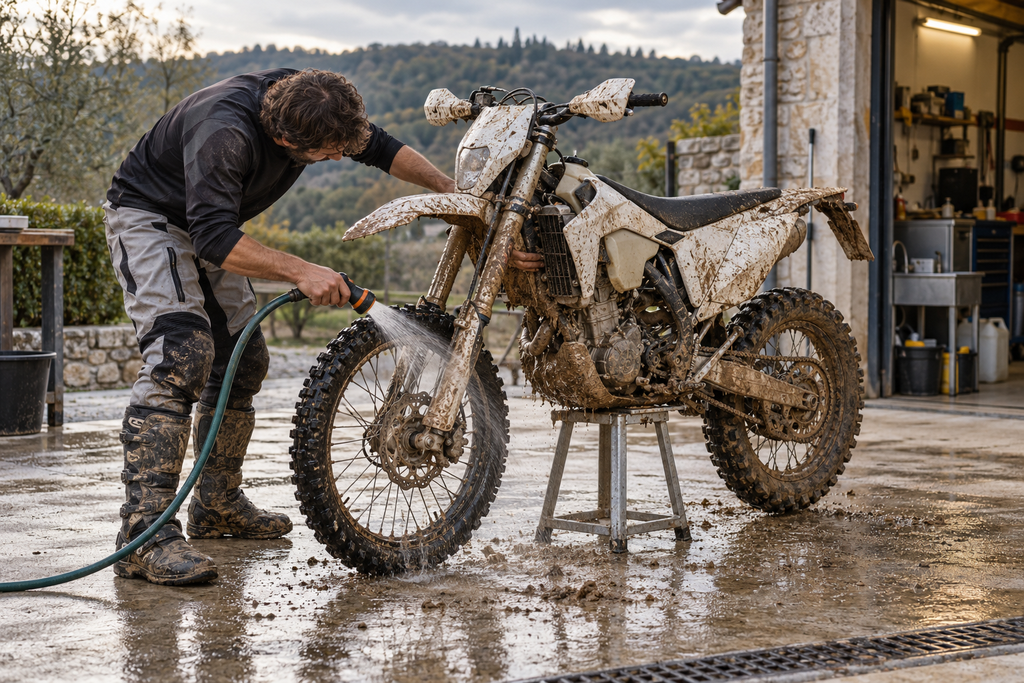
The ride is not finished when the motorcycle returns to the van or workshop.
Thick mud can conceal damage, hold moisture against components and interfere with cooling if it blocks the radiator. Clean the motorcycle before the dirt hardens, but avoid forcing high-pressure water directly into bearings, seals, electrical connectors and the air intake.
Pay attention to:
- radiators and cooling fins;
- chain and sprockets;
- brakes;
- fork seals;
- footpegs and controls;
- the area around the airbox;
- wheels and spokes.
After cleaning, inspect the motorcycle for damaged parts or fluid leaks. Lubricate the chain as appropriate and allow boots, helmet padding and protective equipment to dry properly before the next ride.
If the motorcycle has been submerged or water may have entered the intake, do not attempt to restart it repeatedly. Follow the correct recovery procedure or seek mechanical assistance.
Mud improves your riding when you stop fighting it
Wet terrain makes mistakes more obvious. Abrupt throttle inputs create wheelspin, harsh braking locks the tyres and a rigid body amplifies every movement of the motorcycle.
This can be frustrating, but it also makes mud a valuable teacher.
Once you learn how to ride a dirt bike in mud, you become more sensitive to traction on every surface. You begin noticing how much power the ground can accept, how small changes in body position affect the tyres and how momentum can carry the motorcycle through a difficult section without excessive speed.
The aim is not to prevent every slide. On a muddy trail, the motorcycle will move. The goal is to remain relaxed enough to recognise which movements require a correction and which will resolve themselves if you keep looking ahead.
If you want to practise muddy enduro riding on routes matched to your level, explore the Enduro Experience Croatia packages. A local guide can adapt the route to current trail conditions and help the group build confidence without beginning on terrain that is unnecessarily difficult.
Frequently asked questions
What is the best way to ride a dirt bike in mud?
Maintain controlled momentum, keep your body relaxed and use smooth throttle, clutch and brake inputs. Look ahead, choose lines with visible texture and allow the motorcycle to move slightly beneath you.
Should you stand or sit when riding in mud?
Standing usually offers more freedom across ruts, bumps and changing terrain because the legs can absorb movement. Sitting forward may improve front-wheel grip during slow, slippery turns. The correct position changes with the section.
Which gear should you use in mud?
Use a gear that produces smooth power without forcing the engine to labour. A slightly taller gear can soften throttle response, but one that is too high may require excessive clutch slipping. The best choice depends on the engine, slope and mud depth.
Should you accelerate when a dirt bike starts sliding?
Avoid a sudden throttle reaction. A small, steady amount of drive can help stabilise the motorcycle, while a large increase may create more wheelspin. Look towards the intended line and keep your body relaxed.
How do you stop a dirt bike in mud?
Brake earlier and apply both brakes progressively. Avoid abrupt pressure and try to keep the wheels turning. Reduce speed before steep descents or slippery corners rather than waiting until the motorcycle is already on the lowest-grip surface.
Are lower tyre pressures better in mud?
A moderate reduction can help the tyre conform to the ground, but excessive reduction may cause pinch flats, tyre movement or unstable handling. Suitable pressure depends on the tyre, motorcycle, rider and whether the system uses tubes, Tubliss or mousse.
Why does my rear wheel keep spinning in mud?
Possible causes include abrupt throttle, excessive torque, poor body position, worn tyres, unsuitable pressure or a line with little texture. Reducing power slightly and releasing the clutch more progressively may help the tyre regain grip.
How can I practise muddy enduro riding safely?
Begin on a wide, level section with no major obstacles. Practise smooth starts, controlled braking and gentle turns before attempting steep climbs or deep ruts. Ride with another person and wear complete protective equipment.